

Is Rerolling Worth It?
If you have the time to do so, you can certainly go for it. CZN’s rerolling process can take a while per reroll, but you don’t need to use salted email accounts since the game allows you to delete user data directly.
- You can use the same login info to reroll by deleting your user data through the in-game menu.
- Each reroll takes about 15–20 minutes to play through the entire tutorial.
- Dialogue has a fast-forward button, but no skip button.
- You are guaranteed a 5★ Combatant character within the first 50 pulls you do on the Beginner Banner.
How many pulls you're able to do per reroll?
Currently you will receive 20 standard banner tickets from the pre-register rewards + 10 from various emails. On top of that, enough currency to do 10 pulls on the rate up banner.
How do I reroll in Chaos Zero Nightmare?
Here’s a step-by-step breakdown on how rerolling will go:
- Play through the tutorial.
- Prologue 1: The Blue Pot (Battle Tutorial)
- Prologue 2: A Promise Unkept (Battle Tutorial)
- Chapter 1-1: Back to the Blue Pot (Story)
- Chapter 1-2: Eye of the Storm (Chaos roguelike stage)
- Pull on the Standard banner (called Combatant Rescue in-game).
- After getting a 5★ on the standard banner, you can switch to the the beginner banner (Special Rescue Request) that guarantees a 5★ within 50 pulls - this way you will start with two 5★ (one you rerolled for and one random).
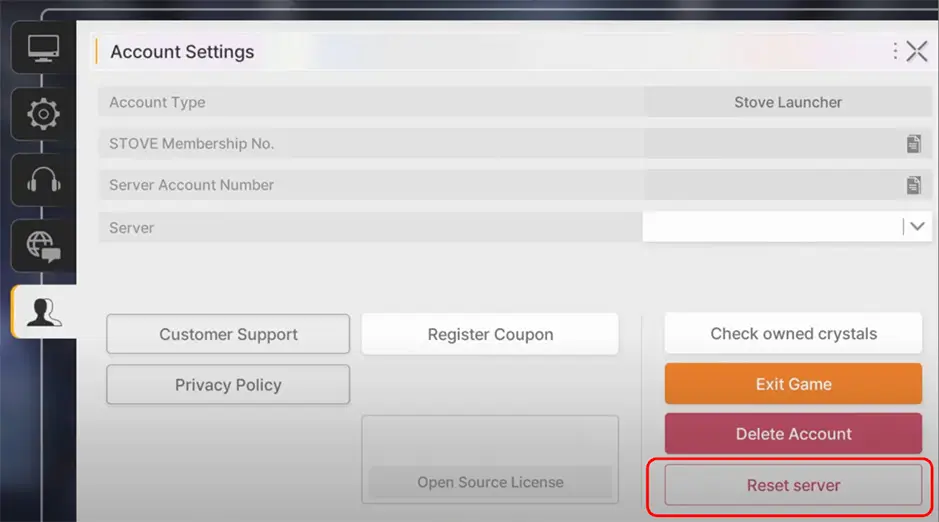
- If you don’t get what you want, use the hamburger button ≡ on the top right corner.
- Click the gear icon to access Settings.
- Click the person icon to access your account settings.
- Click Reset Server. This requires you to enter your username.
- Repeat.
Check the video below how to do that:
Which 5★ can I get from rerolling?
Reroll value explanation
- - The best and most versatile options.
- - Next best characters you can go for.
- - Great characters to have on your account.
- - Niche characters who may require extra support from teammates to truly shine.
Reroll options
Diamond Reroll Value

Introduction
Veronica is a 5-Star Passion Ranger Combatant that hunts their enemies down from the backline whilst also offering amazing supporting capabilities.
Veronica delivers their damage via their Ballistas, which are unusable Attack Cards that activate themselves at the end of the turn for no cost. Her Ballistas are created from her Firing Preparation Upgrade card and can change the type of Ballista created via alternative Epiphanies to adjust how she delivers her damage.
Veronica can fill into an amazing support DPS thanks to having multiple different sources of low-cost Card Draw built into their kit from their Repose and Sir Kowalski cards, combined with the majority of her damage coming from her freely created Ballistas, can also dish out some great damage without needing any direct investment. As Veronica also comes with multiple upgrade cards, her deck can very quickly become an extremely small and consistent draw engine to help cycle through your deck as quickly as possible. Veronica can also boost her Ballista damage massively via the stackable Reload buff.
Because Veronica's Ballistas activate during the end phase and target enemies randomly, it can cause her damage to be quite random and if you aren't able to consistently stack her Reload buff, their damage can sometimes fall a little short.
Piloting Veronica effectively is relatively straightforward: create Ballistas, stack her Reload buff and support your team with her amazing Card Draw.
Veronica truly is one of the best supporting-DPS characters, with all of this taken into consideration and can almost fit into every single team with ease.
Read more
Pros & Cons
Phenomenal targeted Card Draw that can become even stronger with Epiphanies.
Consistently deals damage every turn with Ballista Cards at 0 AP cost after initial setup.
Upgrade-heavy card pool thins out deck size for other Combatants.
Impressive, mostly passive damage, assuming Reload is kept active.
Limited AoE - only accessible via Epiphanies and Ego Skill.
Ballistas target enemies randomly.
Optimal damage output relies on stacking Reload, which isn’t always easy
Upgrade-based strategy requires upfront AP investment to get going.
Performance
Gold Reroll Value
Introduction
Mei Lin is a 5-Star Striker that belongs to the Passion attribute. Mei Lin excels at dealing single-target damage to knock her enemies out.
Mei Lin is capable of constantly applying Passion Weakness to enemies, ensuring she almost always has an Attribute advantage to maximize her damage output. Mei Lin can also inflict "Ember" on her enemies, which provides extra damage to Attack Cards when they're used on enemies that will be put into a Ravaged state or are currently in one.
Mei Lin has phenomenal AP efficiency and consistency thanks to her "Unity of Attack and Defense" card. She has great self buffs and can dish out some incredible damage without much help from other Combatants. Mei Lin is primed to be your key DPS in a team and benefits best from other Combatants who can provide buffs to supplement their damage output.
Her glaring weakness is her lack of AoE damage; none of her cards or various Epiphanies have the ability to provide in this area. In content where AoE is needed, she may fall short. Whilst Mei Lin has Card Draw on her own, it's limited to her own cards, so she will still want to be paired with another unit who can assist with Card Draw to ensure she can activate as many of her cards as possible in a single turn.
Mei Lin plays almost like a fighting character, chaining together long strings of Attack Cards to form potent ramping combos to continue her assault.
Read more
Pros & Cons
Self Card Draw/searching and AP cost reductions.
Incredible self-buffing capabilities.
Can apply Passion Weakness on enemies to always deal Tenacity Damage and gain attribute damage bonus herself and Passion Allies.
Outstanding burst single-target damage.
Ego Skill is expensive
No AoE Cards.
Performance
Introduction
Narja is a jack-of-all-trades unit capable of performing multiple roles at once, while also having a specific niche as a Defense-Based Damage Buffer. However, at the time of her release, this build isn’t capable of being used to its full potential.
Narja deals solid damage in both single-target and AoE scenarios. She can also reduce Card Costs to boost AP efficiency, while enabling some combos that normally can’t be used through standard AP generation. Her kit is built around granting consistent buffs to the team while also providing incredible passive healing delivered at close to no cost. Outside these basics, she possesses multiple Epiphanies that allow her to specialize in different builds like DPS, the aforementioned DEF Damage buffing, Basic Attack buffing and even huge single-card buffing - all without sacrificing much of her all-rounder nature.
The heart of Narja’s kit is her Voracity and Predation buffs, which are both special stackable buffs she accumulates via her abilities. Consuming these is what makes up the bulk of her standard healing and damage increases.
All of Narja’s buffs and healing, alongside her solid personal damage and card discounts, position her very well within Chaos-based modes, where consistency and balance are valued highly. However, in Save Data-based modes, Narja’s all-rounder faces stiff competition from other controllers who can outperform Narja when specializing in a single avenue of support. Characters like Rei can buff allies more generically and with fewer conditional requirements. Mika generates AP without having to land discounts on the right cards, along with directly healing, which is important for some teams.
Narja can certainly slot into many, if not all, teams well enough. Still, when it comes to the cutting edge, many may consider her a sidegrade or alternative rather than a straight power-up. There are exceptions to this, though and those are the incredibly powerful niches some of Narja’s Epiphanies open up, the strongest of which is her ability to massively buff specifically Defense Damage Dealers. The only problem with this niche is that it’s currently lacking support, watering down one of Narja’s largest potential strengths.
In Chaos, Narja’s all-around kit makes her a stand-out unit, capable of carrying many types of teams all by herself. In Save Data game modes, Narja is currently unable to fully express her maximum potential due to some of her strongest builds currently lacking team members to thrive.
Read more
Pros & Cons
Additive damage buffs through Voracity and Predation.
Passive healing that occurs constantly for close to free.
AP cost reductions.
Has both single-target and AoE damage.
Multiple different support paths thanks to powerful buff/debuff Epiphanies.
Defense Damage buffing niche.
No Card Draw restricts team and Epiphany options in Save Data modes.
Defense Damage archetype Narja is strongest in currently lack top tier teammates to be used with.
Performance
Introduction
Tiphera is a 5-Star Order Attribute Controller who’s all about combining massive AP production, shielding, plus healing, and strong but restrictive damage buffs to her team. As an extra bonus, in Chaos and in some Save Data builds, she can also contribute a little Defense-Based damage of her own.
Tiphera’s core mechanic is based around her various Archetype cards - Circle, Triangle, and Square. Her Archetypes are 0 Cost Skill Cards that have the [Exhaust] tag and can be generated in large numbers continually every turn through a number of cards in her kit. Each Archetype shape has its own unique effect, but all of them grant either healing or shielding. The unique effects of each archetype are where Tiphera’s kit properly comes into its own, though. One Shape has AP generation, another has a damage buff to the first hit of the next Attack card played, and the last draws other Archetypal cards, ensuring Tiphera’s deck never clogs. Tiphera’s entire playstyle revolves around generating the right Archetype Shapes at the right time for what your team needs in the moment, something which gets especially interesting given the fact that many of the best ways to generate said Archetypes have a significant dash of randomness involved.
One of Tiphera’s main strengths is her ability to hone in on creating as many AP Archetypes as possible, allowing her to generate a staggering amount of AP for the team even without Divine Epiphanies. Because of the amount of AP Tiphera can generate, you can occasionally be left with excess. To solve this, you can consider finding a source of [Stockpile] to conserve it between turns. Alternatively, Tiphera can also switch gears and focus on buffing Archetypes instead in order to majorly amplify specific combatants’ damage to incredibly high levels. And if specialization isn’t your thing, it’s possible to work in part of both approaches for a hybrid playstyle as well. If that wasn’t enough, as an additional bonus, Tiphera gains yet more AP and buffing, but most importantly, some card draw thanks to her Unique Card “Event Horizon” which, depending on your luck, can draw up to 4 cards or generate 4 AP.
When it comes to fitting Tiphera into teams in Chaos, she’s a mostly universal support capable of working with a range of teams thanks to her strong AP generation, healing, shielding, and ability to deal a little damage. In Save-based game modes, however, despite her strengths, Tiphera is not a shoo-in for all teams as her main strengths in Chaos, like AP generation and sustain, are far easier for more characters to cover after considering fully built decks with Divine Epiphanies.
Where Tiphera shines in Save Data is where her powerful but incredibly limited buffs, which only amplify the first hit of the next Attack Card played, can be fully taken advantage of. This means Tiphera is most at home supporting single-hit damage dealers with massive base multipliers that only hit once, allowing Tiphera to take that single huge multiplier hit and massively increase it. This generally means Tiphera isn’t the kind of support who can be paired with any DPS and excel, limiting her use compared to more generalist buffers. However, in the teams Tiphera IS good in, she’s usually one of, if not the best, options.
All up Tiphera is a well rounded beast for Chaos but before slotting her in for Save first track whether the AP she generates (which can be a lot) is useful, if it is, then consider carefully if her buffs make sense for the damage dealer you’re focusing the team around, lastly, either select a Low RNG build or prepare a game-plan to work around the randomness involved in some builds Archetype Creation. Last but not least, make sure you have some draw power covered, either by splashing some draw-based standard/divine Epiphanies on Tiphera or the rest of your team. If you can check all those boxes, it’s very likely Tiphera will serve you and your team well.
Read more
Pros & Cons
Incredible AP generation.
Powerful Healing and shielding.
Large Multiplicative Damage buffs.
Easy deck building thanks to so many unique cards.
Buff only lasts for a single attack and only works on a single hit.
Some top builds feature a lot of randomness, leading to inconsistent fights.
Requires planning on which archetype to aim for when in order to be effective.
When Archetype cards are mismanaged, they can clog the deck.
Performance
Silver Reroll Value
Introduction
Haru is a 5-Star Justice attribute Striker Combatant that constantly drops her Anchor onto her enemies, getting stronger every time she does so.
Haru is a DPS Carry with a kit focused on buffing her expensive cards to deal massive damage. Her main card, “Anchor Shot”, amps up every time it is used, up to ten times, allowing Haru to snowball her damage into big numbers during longer fights. She can do both AoE and single-target damage.
Although her playstyle may seem overly expensive and tricky at first, there are several ways to build around her and adapt to AP needs and different teams, regardless of having an AP Generator in the team or not. With this being said, Haru definitely works best when paired with other Combatants who can provide AP management to ensure she can use Anchor Shot as many times as possible.
If you like big nukes and characters that hit hard, she may be a good pick for you. If you prefer fast but constant, smaller hits, however, she may not be your jam.
Read more
Pros & Cons
Decent AoE and Great Single-Target damage.
Can tutor her Signature Card back to hand.
Good in-built damage scaling.
Ego skill gains extra scaling based on the number of buffs owned (counting both from herself, equipment, other Combatants, etc).
Very Expensive cards and kit.
The scaling mechanic requires cycling the deck many times.
Performance
Introduction
Hugo is a Ranger class Combatant who belongs to the Order attribute, who teams up with his allies to deal damage with Extra Attacks whenever a targeting Attack Card is used.
Hugo's Signature mechanic is called "Commence the Hunt". Commence the Hunt can stack up to 5 times, gaining stacks whenever an Upgrade or Skill card of another Combatant is used whilst under the effect of his own "Hunting Instincts" Upgrade card or via multiple of his own cards. Whenever a targeting Attack Card is used, Hugo will launch his own Extra Attack to that same target, dealing 50% Extra Attack Damage, which increases by 30% damage per stack of Commence the Hunt owned.
Hugo can function as a Primary DPS or a Sub-DPS thanks to being able to passively generate Commence the Hunt from other units using cards. Hugo is looking to be paired with other units that have low-cost targeting Attack Cards to ensure you're using as many Hunt stacks per turn as possible to maximize damage.
Hugo greatly benefits from Morale due to the number of attacks he can potentially launch at his enemies, best pairing him with units who can provide consistent Morale. He also requires a decent amount of Skill cards in his teammates' decks to ensure he can maintain as many Hunt stacks as possible.
As Hugo does heavily rely on his Upgrade cards to get going, he can require a bit of upfront AP investment to ensure he can function as effectively as he can. Hugo also lacks AoE damage outside of his Ego skill, but makes up for it with his huge single-target damage.
Playing Hugo efficiently is all about balancing your Commence the Hunt stacks to deal as much damage as possible, weaving in various Skill Cards and Attack Cards to ensure you're not Overcapping your Hunt stacks.
Read more
Pros & Cons
Absurd sustained single target damage throughout the entire fight.
Strong built-in scaling thanks to Commence the Hunt stacking damage multiplier.
Incredible Card Draw options for a DPS.
Upgrade-based playstyle - can operate without needing to draw specific combo pieces after being initially established.
Limited AoE, only accessible via Ego Skill.
Must be paired with allies that attack frequently to maximize Commence the Hunt triggers.
Commence the Hunt does not trigger unless the abilities target.
Performance
Introduction
Nine is an Order attribute Vanguard who excels at dealing high single-target damage, positioning her as one of the strongest OTK (One Turn Kill) units in the game, thanks to her signature card Hew, an attack you’ll always have in your hand and which levels up as you use it. Nine also has the potential to sacrifice some of her standard single-target damage to branch out into different playstyles through her varied Epiphany options. Doing this can allow Nine to act as a Shielder, AoE damage dealer, or even counterattack specialist.
In all modes of play, Nine’s game plan is simple but effective. Her main card, Hew, has initiation and will start in your hand. It also has exhaust and the new mechanic incinerate, which triggers when the card it’s on is exhausted, and in the case of Hew, adds another copy of Hew to your hand, but at a higher level (which deals more damage).
One way to play Nine effectively is to activate Hew as many times in one turn as possible. Hew does have a limit on how many times it’ll add back in a single turn from incinerate, but you should try to max that out every turn you can when playing this way. This can be hard in Chaos, but it should be your target in Save with this strategy. The catch with this plan is that Hew has a high AP cost of 3, so you’ll have to use the rest of Nine’s kit in order to activate it multiple times per turn. The main card that helps with this is Fighting Spirit, a 1AP card that activates the highest cost Nine card in hand. So the basics are spam Fighting Spirit as much as possible to activate Hew as many times in one turn as you can!
The other way to play Nine is aiming for a single massive hit with Hew by stacking buffs and debuffs while levelling Hew up to maximum through other means. This can either be achieved in a single turn or by waiting multiple turns, with the trade-off being that those turns skipped are lost damage but result in a stronger hit at the end. This playstyle is a valid alternative to using all levels of Hew each turn, but needs more specific builds and a large amount of buffing/debuffing in order to compete.
When it comes to team building, Nine is usually looking to be your primary damage dealer thanks to her high damage output. Her build can be altered to support shielding and sustain, but that’s not the norm. She also doesn’t have any AP generation or Draw. Because of this, she is best paired with characters who can provide one or the other or both, ideally at the same time, as also bringing some buffs to the table. But if you decide to go for the counterattack variant, you’ll want characters who excel at generating counterattack stacks.
For accessing Nine’s different playstyles, it can be done so by swapping out Hew’s max damage option for utility variants, which change the way you build your deck, and who you support her with. Nine has counterattack synergy with her Hew (Ambush) epiphany; whenever your Ally counterattacks, it also triggers your Hew, opening up an entirely different playstyle. Hew (Massacre) offers AoE damage, at the cost of single-target damage. Hew (Ironclad) generates a large amount of shield every time Hew is used. Lastly, Hew (Flash) can be used to solve AP issues when played in Exhaust-based combo decks.
When thinking of scaling Nine’s damage due to her much higher than average base numbers on her cards, she benefits greatly from multiplicative damage buffs over smaller additive buffs, such as Morale stacking. Nine also has a low hit count, which allows her to maximize Vulnerability to its fullest. You’ll want to be looking for as many multiplicative buffs to maximize her damage output while avoiding additive ones.
Read more
Pros & Cons
Strong single-target damage.
Very easy deckbuilding, not reliant on divine epiphanies like some other characters.
Flexible playstyles, able to swap to strong AoE or shielding.
Absurd ability to do ridiculously large single hits of damage with set-up
Her main combo card will always be in hand.
Best decks don’t require many points, so many Neutral cards can be used if desired
No card draw.
Most builds are AP heavy.
Take a bit to get going in Chaos due to Hew’s high cost.
Performance
Introduction
Orlea is an Instinct Attribute Controller that can do it all - she has buffs, debuffs, heals, shields and some damage thanks to her unique mechanic “Creations”. Creations are generated cards with each having its own special use, plus a retain effect. Orlea can generate 3 different types of Creations through her cards, each of which costs 0 AP and has both an on-use and [Retain] effect. The three types of Creations are Toughie, who Shields on use and heals on [Retain]; Swiftie, who gains damage on [Retain] which can be dished out to a target on use; and Softie, who buffs damage (multiplicatively) both when used and on [Retain].
Orlea’s other main claim to fame is her ability to trigger the [Retain] keyword outside of the ordinary activation window through multiple of her cards. This effect single-handedly puts her into consideration in any team that values [Retain]. Orlea herself is a great benefactor of this, thanks to each of her Creations having powerful [Retain] effects, but this can also be a game-changer for some other Combatant and Neutral Cards, unlocking usually impossible strategies.
As strong and flexible as Orlea’s kit is, the one thing she’s missing is natural Draw Power, meaning she’s best paired up with other Combatants that can pick up the slack. The other consideration when team building for Orlea is that her main buffs from Softie are multiplicative, not additive which favors high base value attacks compared to low damage high hit count attacks, which when combined with the fact that Orlea also applies [Vulnerable] as her main debuff means she’s often best used with Damage Dealers capable of dealing maximum damage in singular attacks which hit hard instead of often.
Playing Orlea boils down to leveraging all of her Creations effectively and making use of her ability to forcibly activate [Retain] effects multiple times a turn, every turn. This allows her to both play actively and passively, with the only limiting factor often being getting the Creations you need, plus ensuring you have the hand space to hold onto them.
Read more
Pros & Cons
Capable of decent shielding as well as great passive and active healing.
Can deal a bit of damage when playing around Swiftie.
Highly flexible thanks to so many different Creation effects.
Can be played both actively through forcibly using [Retain] plus passively by maintaining them in hand.
Strong multiplicative card buffing.
Able to trigger her own and other characters' [Retain] effects on demand with some card.
Creations and [Retain] cards can end up clogging your hand when held too long.
No Card Draw.
Certain strategies can require multiple turns to gain value from Creation [Retain] effects
Performance
Bronze Reroll Value
Introduction
Chizuru is a Damage Dealer focused on dealing single-target damage while supporting the team with some AP efficiency and a small amount of healing at the same time. Her kit introduces several unique mechanics to the game and you’re forced to play around them to unleash her full potential - this makes her a bit more complicated to play compared to some other Damage Dealers. If you want to learn about them in detail, check the Key Mechanics section below the review, but here’s the gist of how to play Chizuru: place a debuff on the enemy, attack the enemy either often or with cards that deal a lot of hits (or both) to generate her unique resources and once you manage to convert the base Shadow of the Moon card into its + version thanks to the resource, use the card for a big attack.
Still, you also have to keep in mind that one of Chizuru’s Upgrade card buffs prevents her (and her team) from gaining AP from any source other than Ravaging an enemy. You can opt not to use the card, but you will miss out on some of Chizuru’s damage and one of the most interesting mechanics Chizuru offers that is tied to it - cost reduction of random cards in hand at the start of every turn (1 card at base, but there’s an Epi that increases that to 2 cards). It’s really great in Chaos, turning Chizuru into a ‘reverse Mika’, but in Save modes, it brings less benefits as you have access to better-optimized decks.
Now that you know how Chizuru works, let’s move to the teams you can play her in. And there are two ways you can do it - either by pairing her with another DPS that attacks often without using too much AP, so they can generate a lot of Will-O’-Wisp for her (like Luke or Tressa), which will create a dual DPS team or by pairing her with two supports and leaving the Wisps generation to Chizuru herself. Both are viable in both modes, but dual DPS teams are more reliable in Chaos, while main DPS offer more options in ‘Save’ content.
Another issue Chizuru has is that she’s not really an improvement to existing characters in their teams. Both Luke and Tressa, the teammates she wants to be paired with, work better in their own teams and only reach their full potential there, rather than when played with Chizuru.
Overall, Chizuru continues the trend of introducing characters that aren’t direct powercreep to the release cast and instead she allows for new types of playstyles. She’s not stronger than the current juggernauts when it comes to raw DPS, but instead offers some utility on top of decent single-target damage.
Read more
Pros & Cons
Combines solid ST damage output with team utility.
One of the few characters offering AP efficiency to the team.
Has some healing in her kit, making survival a little smoother.
Has multiple viable builds, allowing her to adapt to the Epis you receive in Chaos runs.
Can be played as main DPS or sub DPS.
No AoE capabilities.
Damage Potential is limited by sufficient Wisp generation; without it, her best card loses significant power.
Can suffer from restrictive team building due to the Inhibit mechanic and Wisp generation requirements.
No extreme scaling attacks, skills, or upgrades limited her top-end Save Data Potential compared to other characters.
Performance
Introduction
Kayron is a Void Psionic that wreaks havoc by truly harnessing the Void to deal devastating AoE and single-target damage.
Kayron has extremely expensive AP costs across the board and demands AP to function due to his "Futility" cards that are created from various sources in his kit. Futility by default are 1 Cost "Status Ailment" cards that feature the [Exhaust] tag, but can be changed into Attack Cards through his "Oath of Vanity" Upgrade card. Kayron can infinitely scale as his "Black Hole" card deals heavy base damage and does extra damage for each exhausted "Futility" card. He can also deal some serious AoE damage via his "Brand of Annihilation", which is a 3 Cost Attack Card that reduces its cost by 1 for each card exhausted this turn.
Kayron relies heavily on supporting characters who can provide AP management via either Cost Reduction to help alleviate his high costs or pure AP Generation to ensure he can [Exhaust] any Futility cards created so he can maximize his damage output consistently, whilst not leaving any unwanted Futilitys to be cycled back into your deck as you very rarely want to be clogging your deck with them.
With most of, if not all of Kayron's qualities being of a pure Damage Dealer, he's positioned to be your main DPS on a team, best paired with other supporting characters who can assist with his high AP demands.
Because of Kayron’s extremely high AP demands, he can struggle in Chaos early, especially if he hasn't obtained his "Oath of Vanity" Upgrade card to turn his Futility cards from dead-weight bricks into damage/healing cards. He can shine in Save Data content where your supports have been built properly to help with his insane AP demands to be able to reach that true late-game scaling monster that he is.
Read more
Pros & Cons
Incredible single-target and AoE damage potential.
Has many gameplay-altering Epiphanies - both mechanically and damage-wise.
Becomes stronger the longer the fight drags on.
High AP costs can be bypassed with smart play.
Many very AP expensive cards on top of Void also costing AP.
Main mechanic Void is not fully functional without the Gold Card Oath of Vanity.
Can clog its own hand and deck with Void, which is too expensive to use if not careful.
Gains so much power from Epiphanies that his base deck can feel awkward and underwhelming.
Hard to play.
Almost feels reliant on his signature partner Bria, to function at a basic level.
Performance
Introduction
Khalipe is a 5-Star Instinct Vanguard that functions as a hybrid DPS/Tank that deals AoE Defense-Based Damage whilst still outputting sufficient shielding to protect her team.
Khalipe's cards are incredibly AP expensive, but her best card, Vulture Ejection, can mitigate this with its [Celestial] tag. [Celestial] cards are used for free whenever you use another card that costs 2 AP or more, allowing Khalipe to spend big once and automatically play her most powerful card for free. Her Vulture Ejection card also generates stacks of "Silver Veil", up to a maximum of 3. When it reaches 3 stacks, Khalipe removes all stacks of Silver Veil and deals heavy Defense-Based damage to all enemies.
Outside of this, Khalipe has targeted Card Draw, decent Tenacity Damage and some good utility Epiphany upgrades. Thanks to how much shielding and damage Khalipe can bring to the table, combined with being able to reliably activate her [Celestial] tagged cards on her own, it grants her incredible team flexibility when deciding who to pair her with.
When deciding on a team, Khalipe definitely favors Combatants who can offer low-cost deck cycling to ensure she has as many [Celestial] cards in her hand at once to chain together, as there’s no limit to how many [Celestial] cards can activate after playing a 2-cost card.
Khalipe’s gameplan truly is simple: hold as many copies of Vulture Ejection as possible, activate any 2-cost card and watch her enemies get picked to shreds while setting up huge shields in the process.
Read more
Pros & Cons
Great single target, AoE damage and Shielding all at the same time.
Can cast Vulture Ejection (and Rally Epi 3) for free with [Celestial].
Awesome targeted Card Draw.
Decent AoE Tenacity Damage.
Access to even more supportive capabilities through Epiphanies.
Requires a 2 AP or higher card to trigger [Celestial].
Without [Celestial] activations, she's just left with many high-cost AP cards that often aren't worth their full price.
Performance
Introduction
Luke is a 5-Star Order attribute Hunter who comes prepared for any encounter, creating a constant flurry of bullets to gun his enemies down with precision.
Luke's playstyle revolves around their different "Shot"/Bullet cards that he generates via multiple of his cards.
Luke can access consistent Bullet generation via his Stealth Reload and Chain Fire cards that allow him to reload his magazine to continue his attack. He has inbuilt buffing capabilities to cards with the [Bullet] tag, opening up potential synergies to other characters who also use [Bullet] cards.
Luke does require a somewhat high Critical Hit Rate (50%+) to be able to consistently access Bullets from his “Chain Fire” card. However, there are many sources of additional Crit Chance through Partners, Gear and Potential Nodes that can help with fulfilling this requirement.
He doesn’t offer any Card Draw in his kit, thus it's best pairing him with units who can help cycle his deck to ensure he can continually generate [Bullet] cards to remain as effective as possible. Thanks to his low-cost Bullet Cards, he doesn’t demand AP to function. As most of hisAttack Cards have low base values and also have access to multi-hitting attacks, Luke benefits immensely from additive Damage buffs such as Morale.
In content where AoE excels, Luke may not be the best pick as he lacks any AoE from his cards. However, he can definitely dish out some extremely consistent single-target damage if built correctly and supported appropriately.
If you like the idea of overpowering your opponents with a non-stop barrage of Bullets, Luke definitely comes prepared.
Read more
Pros & Cons
Solid single-target damage, but must build enough Crit to properly access it.
Generates many 0-cost attacks for free with abilities that scale well with Morale like effects.
No AoE Cards.
Requires Crit investment to function at the highest level.
Hand space issues with [Retain] cards and status effects.
Needs a buffer to perform at an acceptable level.
Performance
Introduction
Magna is a Justice Vanguard who wants to protect her team via huge shields and clapping back at enemies via Counterattacking.
Magna has almost everything you want from your tank. She offers multiple different ways to passively generate shields, which in turn will also generate stacks of Counterattack. Counterattacks occur when you're struck by an enemy unit. When this happens, any unit that holds a stack of Counterattack will immediately retaliate with an attack of their own - dealing 100% Defense-Based damage. If the damage dealt by the enemy when this happens is completely blocked by your team's shield, the damage dealt increases to 200% Defense-Based damage instead.
Magna also has consistent ways to inflict multiple Vulnerable stacks on her enemies via "Frost Charge" to further increase her team's damage output. Magna also has the unique ability to allow her Counterattacks to hit all enemy units, opposed to just the enemy unit attacking.
Unfortunately, Magna does boast higher-than-usual card costs across the board; fortunately, some of these cards feature the [Lead] tag, which gives any card holding this tag a 50% chance to have their cost reduced by 1 at the start of the turn until another card is used. This can help alleviate some of the high costs that come with Magna.
Magna can act as an extremely passive character as well, as quite a few of her cards are Upgrade cards - once these have been played, Magna can simply sit back and passively help her team thanks to having access to Crystallization.
If you’re looking for a character that can apply debuffs whilst protecting your team and even providing some decent damage. Magna is one of the best options.
Read more
Pros & Cons
Good shielding with reasonable damage output after set-up and when being attacked frequently.
Strong access to the Vulnerable debuff.
Nice AoE Potential while Ice Wall is active.
Grants Crystallization for constant shielding without needing to draw or use AP for it.
Has many expensive cards and is incredibly AP hungry.
Counterattacks (and damage) are far less effective in fights where enemies are not often hit.
Performance
Introduction
Renoa is a 5-star Hunter Combatant that deals Void damage and specializes in dealing Single-Target damage through their Dirge Bullets, which trigger an Extra Attack when Discarded by other cards or at the end of the turn.
Most of Renoa’s cards either focus on generating Dirge Bullets or dealing additional damage when Dirge Bullets are in Hand or the Discard Pile. Her gameplay requires setup time for generating Dirge Bullets, card management and planning in order to unleash her hardest-hitting attacks at the right time.
Because of Renoa’s Dirge Bullets triggering when Discarded, Renoa has great synergy with Combatants who can offer deck cycling in the form of Draw and Discard outlets. Due to her high hit count, she also scales extremely well with additive buffs such as Morale.
Unfortunately, Renoa lacks any AoE in their kit and can be very prone to clogging the deck with Dirge Bullets. Renoa can help with some Card Draw of their own with various Epiphanies, but is best poised to be your primary DPS on your team.
If you enjoy unleashing a barrage of attacks each turn whilst still having the opportunity to fire off some burst damage, Renoa can be a combatant to look into, but you’ll need to manage her deck well after the first turn if you want her to last long into fights.
Read more
Pros & Cons
Great single-target and burst damage output.
Powerful personal damage scaling from Dirge Bullets.
Has a few exceptionally strong gameplay-changing Epiphanies.
Launches many Multi-Hits and Extra Attacks that scale well with Morale.
No AoE Cards.
Can clog the deck with Dirge Bullets if not careful.
Timing Ego Skill alongside Dirge Bullet generation and correct payoff cards requires some effort.
Performance
Introduction
Rin is a 5-Star Void-aligned Striker Combatant that sits in the mist, waiting to cut their opponents down with haste.
Rin utilizes “Dark Mist Stance” to enhance her abilities. She enters this stance through specific cards and only exits the stance when another Combatant plays an Attack Card. While the stance is active, most of Rin's cards gain additional effects that allow her to deal fantastic single-target damage while also buffing herself, improving AP efficiency and increasing hit counts, damage multipliers and more. Playing Rin is all about chaining together attacks and staying in her stance as consistently as possible.
As Rin wants to remain in Dark Mist Stance as much as possible to be effective, she isn't looking to be paired with Combatants who require Attack Cards to be played consistently to be effective. She's best poised as a Primary DPS to be supported by the other two team members. Whilst Rin does offer targeted Card Draw and even AP management, she is best paired with units who can offer some consistent Deck Cycling to ensure she can get into Dark Mist Stance to begin with. Rin's Attack Cards also feature multi-hitting quite consistently, taking great advantage of additive damage buffs. Any Combatant who can offer these buffs to Rin can truly make her lethal.
Rin doesn't have any AoE anywhere in her kit, but has incredible single-target damage output. In content where AoE damage is key, Rin may struggle compared to some other Combatants, and vice versa.
If you like the thought of methodical gameplay to maximize your output, Rin might be the character you've been looking for.
Read more
Pros & Cons
Fantastic single-target damage output (when set up correctly).
Has Card Draw.
Great self-damage scaling while Dark Mist Stance is maintained and when played with Skill-heavy allies.
No AoE Cards.
Must maintain Dark Mist Stance to remain effective.
Other Combatants' Attack Cards end Dark Mist Stance, restricting your team options.
Performance
Introduction
Yuki is primarily an AoE-focused DPS that can also be built to focus more on ST damage instead. Her playstyle revolves around drawing cards to activate the [Inspiration] effects of her cards, making building decks with a high amount of Card Draw and hand manipulation especially powerful for her. While playing Yuki in her optimal teams (so with Card Drawers like Veronica, Nia, or Cassius), expect to be constantly cycling through your deck with high-end Yuki cards, often playing every Attack Card she has every turn. One other advantage of Yuki after acquiring Epiphanies is that she’s AP-friendly enough that a dedicated AP support isn’t necessarily required, freeing up those supports for other Combatants.
However, Yuki’s reliance on Card Draw to activate [Inspiration] can find her in trouble in non-Save Data game modes, where cheap high-end draw is usually not available. This is especially true early on in Chaos and Zero System runs, resulting in her often having to use her cards without their additional effects, putting her at a disadvantage compared to other characters. On top of this, in higher-tier Chaos, you often have to set aside utility like Card Draw in favor of survivability, which further limits Yuki’s power in non-Save modes. Many of these issues can be fixed with Epiphanies, some equipment and a few lucky card dupes, but none of this is guaranteed.
Thankfully, those issues aren’t a problem anymore in Save Data game modes, as there you already have a good deck saved and can run her with two Card Drawers without risking the team dying suddenly.
Overall, Yuki is a character with an interesting mechanic. Still, she’s being held back by several limitations ingrained into her kit and the fact that her modifiers lack the scaling that other characters have, allowing them to punch above their weight with the right build.
Read more
Pros & Cons
Strong AoE damage output.
Decent ST damage if you adjust your build.
Access to Self Card Draw.
Does not require extra AP generation unless you want to use more expensive, higher damage Epiphany/dupe choices.
Struggles to activate [Inspiration] consistently early in Chaos/Zero system runs.
Her key search card has no options with the [Move] keyword, limiting Yuki to only playing the Attack Cards you hard include in your deck every turn and no more than that, hurting her damage ceiling considerably.
Low Tenacity Damage.
Even in Save Data game modes, she can still draw hands without a way to recycle or activate some of her [Inspiration] cards, leading to efficiency losses.